
Aviation Psychology: Why Planes Are Really Just Flying Therapy Sessions
Welcome aboard, dear reader! Fasten your seatbelt even if you disagree (it’s for your own good), we’ll get to that, because we’re about to take off on a journey through the weird and wonderful world of Aviation Psychology. This is where your cozy, in-flight experience is actually a carefully engineered masterpiece of monitoring human behaviour, and your flight attendants are less “waiters in the sky” and more “psychologists in polyester.”
Roles Within an Airline Cabin Crew Team: The Sky-High Social Experiment
Imagine a team where some people have been flying for decades, and some are fresh out of training. Well, that’s your cabin crew. It’s like a reality show, but at 40,000 feet. There’s the Senior Attendant (flight purser), the wise, unflappable zen master who can de-escalate a passenger tantrum with a single look. Then there’s the Galley Guru, who treats the service cart like a sacred artefact. And let’s not forget the Newbie, wide-eyed, eager, and yet to discover the horror of a “three-hour flight delay” because the APU is INOP.
However, here’s the secret my dear. Despite being a band of strangers at the start of every shift, the crew must quickly become a well-oiled functional machine. They are trained in crew resource management (CRM), which is just a fancy term for “how not to lose your mind when things go wrong.” They know how to communicate without words, how to stay calm when a passenger decides that standing during turbulence is a wonderful idea, and how to cover for each other with a smile that could make steel molten.
How Airlines Handle Turbulence: The Psychology of the Sky’s Bumps
Turbulence is the great equalizer. Whether you’re in first class sipping champagne or in economy wrestling with a broken slanted screen, everyone is subject to those sudden, stomach-dropping bumps. Heck, your ears still pop whichever class you are. The crew, however, are trained to manage the psychology of turbulence. For them, it’s as if you’re walking on a moving bus.
So why do some passengers panic? It’s all about loss of control. In the cabin, you can’t see the pilots, what’s in front direction-wise, you can’t control the plane, and your entire trust is placed in a thin metal tube hurtling through the sky and arranges you barely know get you where you want to go. Flight attendants know this, which is why they remain calm, (or try to), smiling, and strategically reassuring. A simple sentence to someone afraid of heights such as “It’s a potholed sky today, totally normal!” can transform a nervous flyer into someone who might even try to nap.
Let’s sing! “rock-a-bye baby, in the tree top…R
Airline Classes: The Psychology of Status at 40,000 Feet
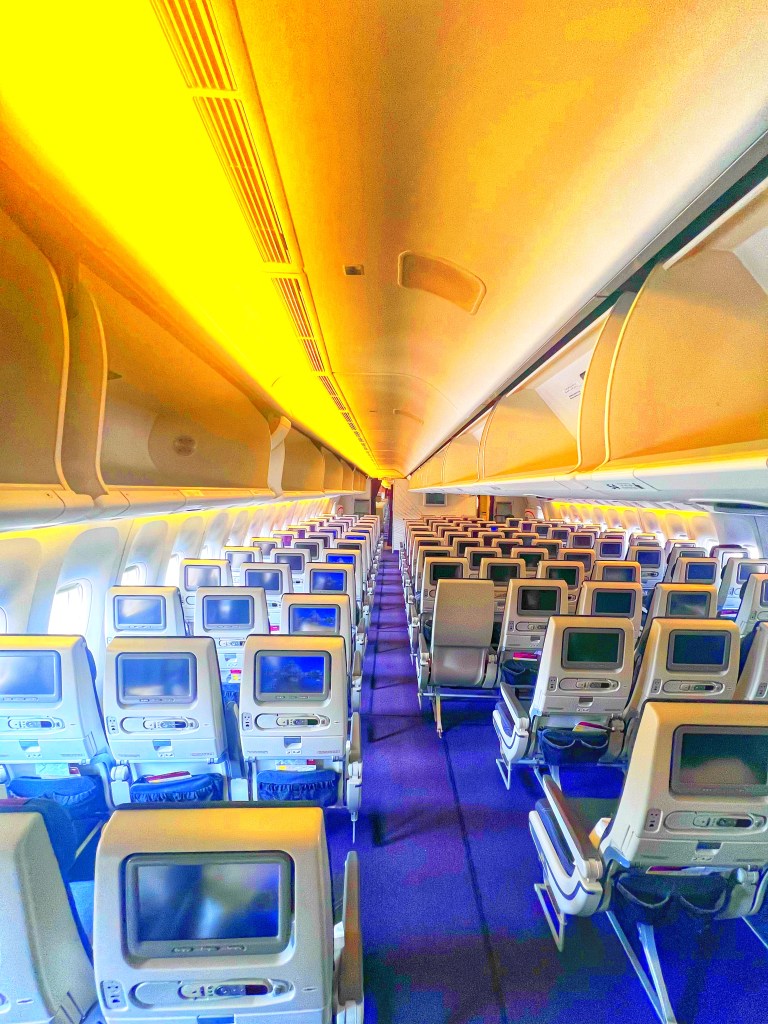
Welcome to the sky’s social hierarchy, where your seat number is an indicator of your perceived importance. In first class, you get a bed, a gourmet meal, and a hot towel so fancy it feels like an apology for the rest of the plane’s existence. Business class is a taste of luxury enough to make you feel important, but not enough to stretch out like a king. Economy class? That’s a test of patience, where your only luxury is the chance to stretch your legs, if you’re lucky that is.
Even so, this isn’t just about legroom. It’s social psychology in action. Humans are wired to seek status, even at 40,000 feet. Those plush curtains separating cabins are more than just a fabric but psychological barriers. First and business-class passengers experience a boost in self-esteem. Economy passengers? Well, they get a crash course in stoic philosophy.
Behind the Scenes of In-Flight Meals: Psychology on a Plate

Ever wonder why your in-flight chicken tastes like it spent its whole life begging for mercy? Welcome to the psychology of airline food. Cabin pressure and low humidity dull your taste buds, which means that a dish that’s flavourful on the ground tastes like a culinary crime scene in the air.
Airlines carefully design meal service to create a sense of routine because it’s not just about feeding you, it’s about creating a comforting ritual. Even the clinking of plastic cutlery is a subtle signal that things are normal, and normal is exactly what you would want at a high cruising altitude.
Future of In-Flight Entertainment: Psychological Tricks to Keep You Happy
Have you any memory of when in-flight entertainment was just a tiny screen showing a movie you didn’t willingly select? Not anymore! Presently, it’s an entire ecosystem designed to keep you calm, happy, and too busy to realise you’re hurtling through the sky in a metal tube with strangers.
There’s psychology in the variety itself from a mix of movies and shows, music, religious content and games, hence ensuring that every type of traveler has something to focus on. It gets fancier! You have a Moving Map and camera, allowing you a view of outside conditions, a subtle way of assuring you that progress is being made. Nothing says “we’re not flying aimlessly” quite like a tiny animated airplane slowly crossing comtinents.
Passenger Safety: The Subtle Art of Managing Panic
“Ladies and gentlemen, please ensure your seatbelt is securely fastened…” It’s a sentence you’ve heard a thousand times, but have you ever wondered why they keep saying it? This is psychology 101. Repetition creates compliance. Safety instructions are delivered with a tone that says, “This is routine,” because the last thing you want in an emergency is people panicking.
Cabin crew are trained to use calm but authoritative voices, maintain eye contact, and keep their own body language relaxed. If the crew appear worried, passengers will replicate the emotion ten times over. It’s part stage performance, part mind trick.
Sky-High Psychology: More Than Just a Flight
A flight is not just a journey from point A to point B. It’s a floating psychological experiment, a test of human behavior, trust, patience, and occasionally, sanity. The crew are not just there to serve you drinks, they are your therapists, your safety experts, and sometimes your personal comedians.
So, next time you buckle up, order your in-flight meal, or glance nervously out the window during turbulence, remember that you’re in a carefully engineered world of aviation psychology, and your cabin crew are the quiet geniuses making sure your brain stays as calm as your seatbelt should be.
 A rose 🌹 a day...